OWSD and GenSIS at the Global Research Council 2026 in Bangkok
Bangkok, Thailand — 16–20 May 2026
 OWSD Secretariat


When OWSD arrived in Bangkok for the 2026 Global Research Council (GRC) Annual Meeting, it stepped into a global conversation in transition: one moving beyond participation numbers toward deeper questions about how science systems themselves can become more inclusive, resilient, and equitable.
But this was not just a meeting OWSD attended. It was a week of active engagement, convening, and relationship-building, bringing together its own delegation and invited contributors to shape discussions on gender, inclusion, and science governance.
At the heart of OWSD’s presence was GenSIS (Gender in Science, Innovation, and Systems), a flagship initiative implemented with UNESCO and funded by Canada’s International Development Research Centre (IDRC). Increasingly, GenSIS is demonstrating how evidence can be translated into institutional change—an approach that closely aligned with the priorities emerging across the GRC meeting.
Bringing GenSIS from evidence to practice
The OWSD Secretariat was represented in Bangkok by Director Tonya Blowers, Senior Consultant Sena Galazzi, and Pukar Malla of the Nepal Leadership Academy, which is delivering a leadership curriculum for OWSD National Chapters and the Executive Board with a strong focus on GenSIS.
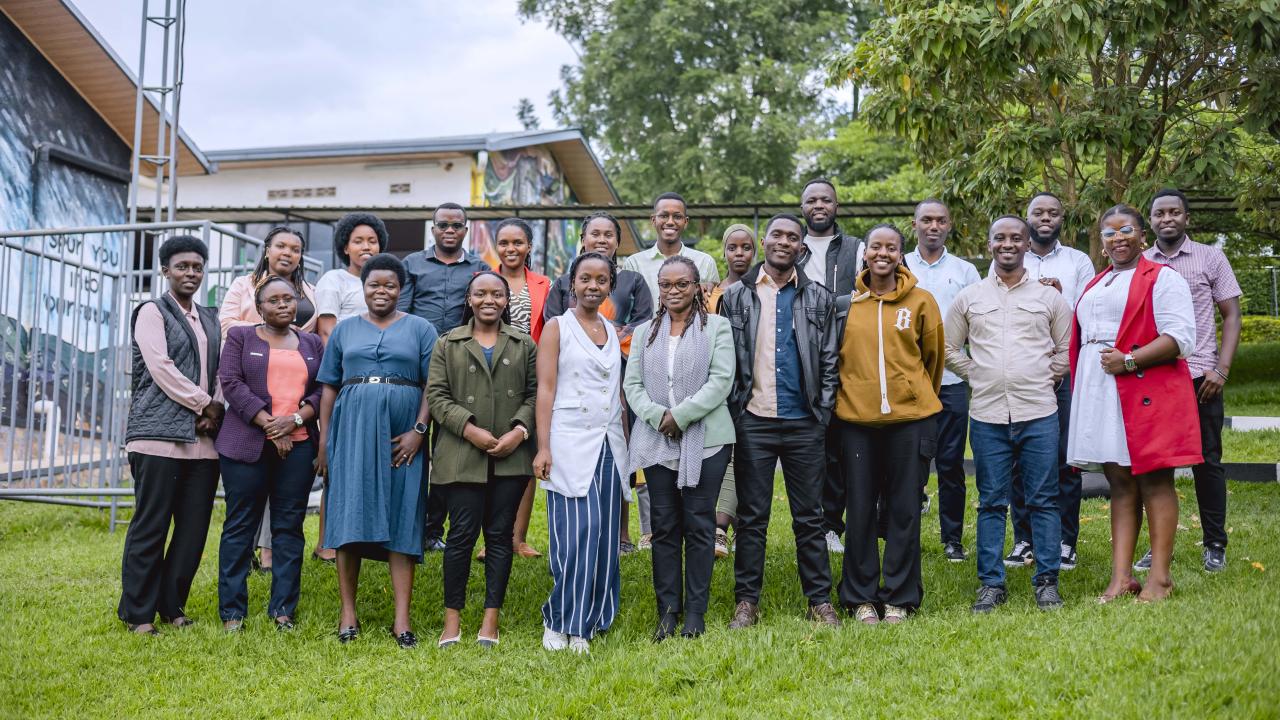
They were joined by colleagues directly involved in the GenSIS pilot phase, whose participation brought a strong implementation perspective to the discussions. From Bolivia, Cecilia Soto, Chair of the OWSD National Chapter, contributed insights grounded in national-level engagement. Rwanda was represented by Didaciene Mukanyiligira, Technology Innovation and IP Analyst at NCST, and Marie Sagesse Uwurukundo of the OWSD National Chapter. From Zimbabwe, Electodom Matandirotya, CEO of the Centre for Education, Innovation & Research Development, and Blessing Magonziwa of the OWSD National Chapter brought perspectives shaped by their work on the ground.
These three National Chapters contributed to the project’s data collection phase and are now involved in its next step: working hands-on with policymakers to establish Gender in Science (GIS) committees. Their presence ensured that conversations were anchored in real experience: what it means to move from identifying gaps to building institutional responses.
This shift came into focus during the joint OWSD–GRC Equality Diversity and Inclusion (EDI) Group side event on 18 May, where participants reflected on the transition from analysis to action. Rather than focusing solely on findings, the discussion centred on how countries can create the structures needed to address persistent inequalities in science systems. The exchanges made clear that while data on gender disparities is increasingly available, effective mechanisms to act on that evidence remain limited.
As one reflection from the delegation captured it, the challenge is no longer simply to measure inequality, but to build the systems that can change it.
Amplifying Global South leadership
These themes were echoed during the IDRC Global South Day, held ahead of the main meeting. In this setting, OWSD Director Tonya Blowers facilitated discussions that connected national experiences to broader debates on science governance, drawing out common challenges across regions.
For the GenSIS participants, this was an opportunity to position their work within a wider movement toward more inclusive and context-responsive science systems. Despite differences in national contexts, many of the structural barriers they described - relating to institutional culture, career pathways, and governance - resonated across countries. What emerged was a shared understanding that coordinated, system-level approaches are needed, and that initiatives like GenSIS can provide a practical framework for doing so.
Leadership as a driver of systems change
Leadership development was a central component of OWSD’s engagement throughout the week. On 19 May, OWSD convened a dedicated GenSIS leadership training session, delivered in partnership with the Nepal Leadership Academy.
Rather than focusing on reporting progress, the session created space for strategy, peer learning, and skill-building. Participants worked through how to engage effectively with policymakers, how to sustain multi-stakeholder GIS committees, and how to translate research findings into concrete institutional reforms.
Bringing together representatives from Bolivia, Rwanda, and Zimbabwe alongside OWSD leadership and partners, the training also fostered exchange across contexts. Participants were able to compare approaches, identify common challenges, and refine their strategies collectively.
The session reinforced a key principle underpinning GenSIS: that evidence alone is not enough to drive change. Institutional transformation depends on people who are equipped to lead: individuals who can navigate policy environments, build alliances, and sustain momentum over time. As reflected during the training, data does not change institutions on its own; it must be carried forward by capable and confident leadership.
Positioning GenSIS within global science governance
Across the GRC meeting, discussions repeatedly pointed to a broader shift in how inclusion in science is understood. The focus is increasingly on systems, on governance structures, institutional cultures, and the long-term conditions that shape participation and leadership in research.
In this context, GenSIS stands out for its integrated approach. By connecting data collection with policy engagement and leadership development, it offers a model for translating global commitments on gender equality into practical, country-level action.
OWSD’s active engagement throughout the week ensured that this approach was visible not only as a project, but as part of a wider evolution in science governance thinking.
Looking ahead
The Bangkok mission also opened new avenues for engagement, including discussions around establishing an OWSD National Chapter in Thailand and strengthening partnerships across Southeast Asia.
At the same time, it highlighted a broader opportunity. As international attention shifts toward resilience, inclusion, and structural reform, there is growing demand for approaches that bridge research, policy, and practice.
Through GenSIS, OWSD is responding to that need—supporting countries as they move from analysis to action, and helping to build science systems that are not only more inclusive, but better equipped to sustain change over time.

OWSD Delegation during the leadership training