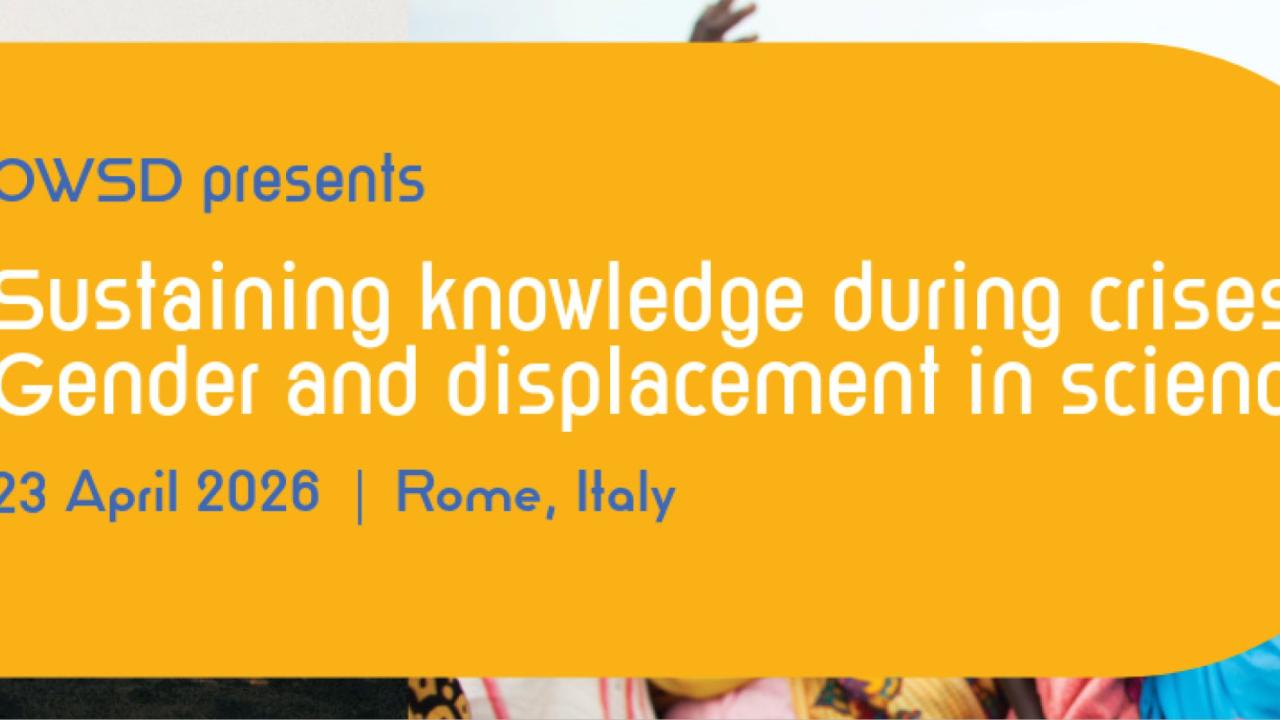
Rome Conference "Sustaining knowledge during crises: Gender and Displacement in Science"
 OWSD Secretariat


Within the framework of the WISDOM programme OWSD held the international conference “Sustaining Knowledge During Crises: Gender and Displacement in Science” at the Accademia Nazionale dei Lincei in Rome (Italy) on 23-24 April. OWSD is truly thankful to Prof. Alberto Quadrio Curzio, OWSD Ambassador and Professor Emeritus at the Accademia, for supporting us to make the event happen. We were honoured to be hosted in a venue rich in history and art, holding such significant importance for Italy's scientific contributions.
The event convened scholars, practitioners, and displaced women scientists to examine how scientific knowledge can be preserved and advanced under conditions of conflict, crises, and forced displacement. Through panels, round tables and personal testimonies, the event highlighted not only the profound challenges facing displaced women scientists but also their agency, leadership, and critical role in safeguarding knowledge for future generations.
In total, the conference brought together 50 participants in person, including 18 speakers, representing 31 countries. Notably, 17 participants came from countries in crisis or had personal experience of displacement, with voices from contexts such as the Democratic Republic of Congo, Myanmar, Syria, Sudan, Afghanistan, Yemen, and Palestine. Representatives from the Embassies of Cameroon and Ivory Coast were also present and so were researchers from the Consiglio Nazionale delle Ricerche (CNR), UNICEF and Italian Universities. The event was also streamed live on the OWSD YouTube channel, reaching a broader global audience and attracting over 240 views on both days, underscoring the international relevance of the discussions. The recordings of the event are available and can be watched at this link https://www.youtube.com/@owsdsecretariat/streams
A central theme of the conference was the strong sense of responsibility and ethical commitment expressed by displaced women scientists toward their communities, students, and societies. Continuing to teach, research, and mentor in times of crisis was consistently framed not as a personal ambition but as a moral obligation. However, speakers also emphasized the heavy emotional and psychological cost of this persistence, describing displacement as a continuous and cyclical condition rather than a temporary disruption. Anxiety, exhaustion, and survivor’s guilt were recurring concerns, calling attention to the need for long-term institutional care and mental health support.
The conference strongly challenged narratives that reduce displaced women scientists to passive or fragile victims. Participants asserted the continuity of their scientific identity, even when universities collapse, laboratories are destroyed, or careers are interrupted. Many spoke about teaching in informal spaces, mentoring from exile, or conducting research without pay as deliberate acts of resistance and self-preservation. At the same time, they critiqued host systems that allow refugee status to eclipse scientific expertise, resulting in devaluation, invisibility, and loss of knowledge.
Gender and intersectionality were highlighted as key factors shaping displacement experiences. Women described navigating care- giving responsibilities, safety concerns, legal precarity, and rigid academic structures simultaneously. The conference emphasized the need for flexible support mechanisms, especially in relation to age limits, career timelines, and productivity metrics that disproportionately disadvantage displaced women scientists.
Finally, the conference called for a shift from ad hoc emergency responses to structural, anticipatory, and inclusive systems. Beyond scholarships, participants emphasized the importance of mentorship, academic recognition, co-authorship opportunities, mental health support, and the active inclusion of displaced women scientists in designing the very programs meant to support them.
Overall, the conference delivered a clear and urgent message: sustaining knowledge during crises requires sustaining scientific identity and agency and collaboration with institutions in the global North. Supporting displaced women scientists is not charity—it is an investment in the future of science, education, and global knowledge systems.