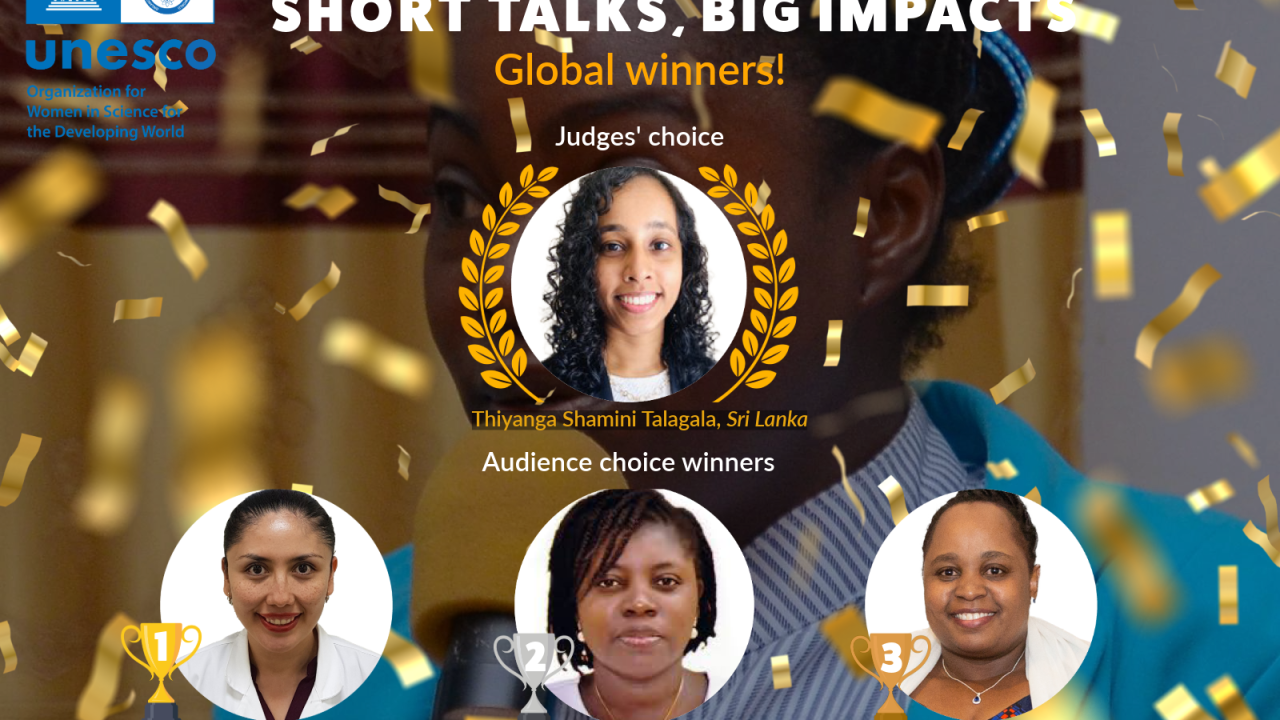
How I managed my precious 180 seconds at the 2025 Short Talks, Big Impacts Competition
Insights and strategies from the Jury’s top‑ranked speaker


When I first heard about the OWSD “Short Talks, Big Impacts” competition, I knew it would not be just another presentation. I had 180 seconds - no more - to communicate years of research, spark curiosity, and leave a lasting impression on the audience and judges.
My talk, “Exploring Artistic Legacy: Analyzing Artifact Differences Across Kingdoms Using Machine Learning,” reflected my dual identity as both a data scientist and an artist. It was also a celebration of the mathematical beauty embedded within cultural heritage.
Preparing for the Competition
The entire process was extremely well organized. From the early stages, the OWSD Secretariat guided participants with care and clarity. We received:
- detailed information on the judging criteria,
- examples of impactful short talks, and
- a walk‑through of how the competition would unfold, including timing and technical arrangements.
All these resources were invaluable in helping me understand what makes a three‑minute talk memorable. They also helped calm my nerves. Knowing what to expect gave me a sense of confidence and structure.
Designing a Three-Minute Story
Condensing complex research into a message that is both accurate and accessible was one of the biggest challenges. I didn’t want to oversimplify my work, but I also wanted to avoid overwhelming the audience.
To find the balance, I focused on clarity, familiarity, and storytelling.
Strategy 1: Start with what people know
I began by connecting two seemingly different worlds—art and data science—through a shared idea:
“Artists see patterns in shapes. Data scientists see patterns in data. They both tell stories about the world.”
This familiar starting point helped bring the audience with me as I gradually introduced the idea that machine learning can reveal mathematical structures hidden in historical artifacts.
Strategy 2: Let visuals do the work
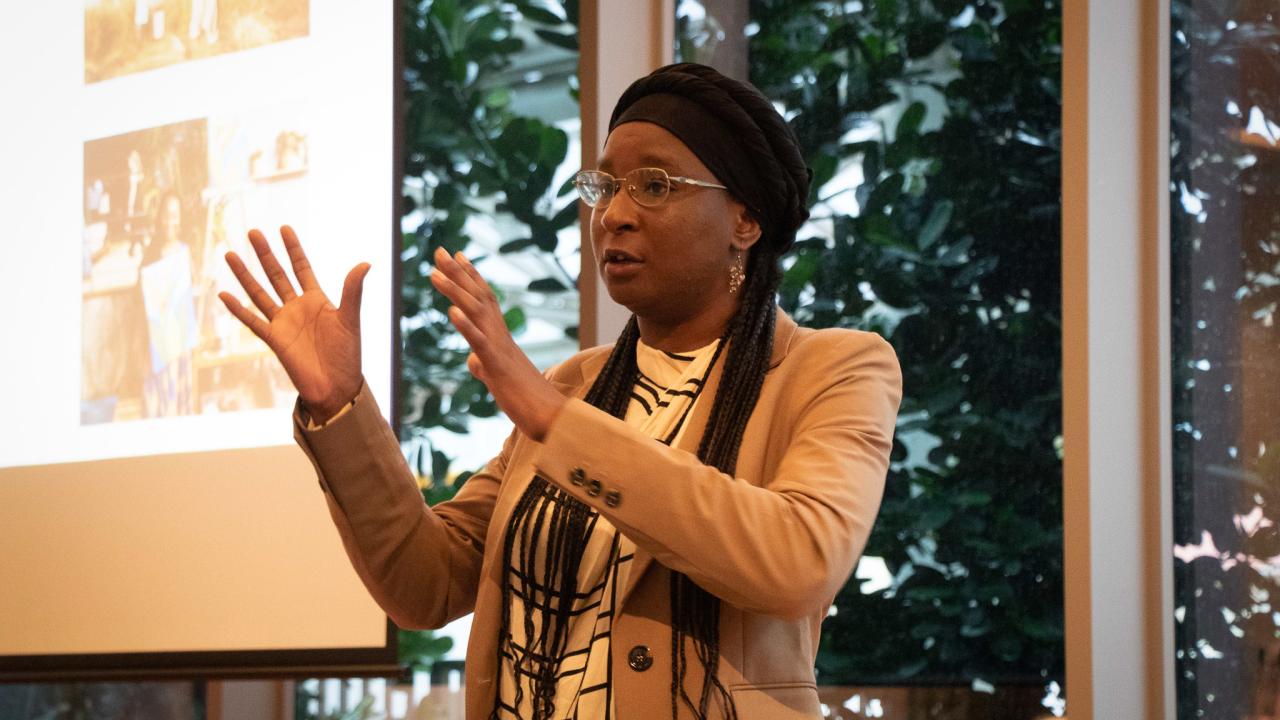
A well‑chosen image can communicate more efficiently than a long explanation. I selected visuals of ancient murals, artifacts, and geometric patterns to help the audience understand concepts like symmetry, tessellation, and structure—without needing any technical background.
Strategy 3: Connect with context
My talk took place on World Mathematics Day, whose theme that year was “Mathematics, Art, and Creativity.” This alignment gave me an opportunity to anchor my message in a broader global conversation.
I also arranged my speaking environment to reflect the connection between mathematics and creativity. This visual coherence strengthened the overall narrative.
Strategy 4: Practice the ideas, not the script
One decision I am especially grateful for: I did not memorize my talk.
Memorizing can flatten the natural rhythm of speech. Instead, I practiced enough to know my structure and key points, allowing the actual delivery to remain spontaneous and genuine.
What the Experience Taught Me
The competition taught me that clarity is more powerful than complexity. If an audience walks away remembering one central idea, then the communication was successful.
I also learned how deeply storytelling enhances scientific communication. A story turns abstract ideas into something relatable and worth caring about.
The most rewarding part was the feedback afterward. Many participants told me they had never thought about the connection between mathematics and art before. Some became curious about the hidden patterns in cultural heritage—and that spark of curiosity is the true reward for any communicator.
The Impact Beyond the Competition
The insights I gained from preparing my short talk have since become part of my teaching. I now integrate them into university courses such as Scientific Writing and Communication, and Essential Skills in Statistics for undergraduate and postgraduate students in Statistics, Data Science, and Artificial Intelligence.
I have also been invited by several organizations to deliver workshops on scientific communication and data storytelling.
Most importantly, the competition gave me a platform to highlight the mathematical concepts embedded in Sri Lanka’s artifacts and paintings, and to show how technology can help preserve and celebrate this heritage globally.
Participating in the UNESCO–OWSD Short Talks, Big Impacts competition gave me more than just visibility. It taught me how to distill ideas with intention, how to communicate science with heart, and how to make every second matter.
Acknowledgements
My sincere thanks go to Erin Johnson and Giulia Signori of the OWSD Secretariat. Their encouragement, guidance, and attention to each speaker’s strengths made the experience truly enriching. The entire event was a lesson in thoughtful planning and meaningful engagement.
I am also grateful to UNESCO–OWSD and The World Academy of Sciences (TWAS) for creating such an impactful platform for women scientists.
My 180 seconds were brief, but the impact will stay with me for years to come.
This article was adapted, with the author’s consent, from a piece originally published on her personal blog. The original version is available at:
https://thiyanga.netlify.app/post/owsd/
As a result of winning the competition, Thiyanga was also invited to the OWSD General Assembly in Colombia, where she had the opportunity to present her work once again, connect in person with many members of the OWSD community, and further expand the impact of her research. (This note was added with her agreement following the original publication of the blog post.)